The Trauma You Inherit
What a Psychedelic Ceremony Revealed About the Pain That Was Never Mine
There is a moment in a ceremony when the question arrives on its own.
Not a thought. A knowing.
I was lying on my back. There was a meditation cushion on my abdomen, to ground me, to help my body feel safe. And the sensations in my womb had become so intense that I had stopped trying to understand them and started only trying to stay with them. Then one of the guides put her hands on the cushion and began to press, slowly, in a circular movement. The energy that had been building moved. And with it came everything else — fear, powerlessness, hopelessness, crying. All of it tangled together in a way I could not make sense of.
So I asked. Because that is one thing you can do in a ceremony. You can ask the medicine a question and wait.
This post began as a Facebook Live — Ioana thinking out loud the day after the ceremony. Watch the full account here.
What came back was not a sentence.
It was a deep, settled certainty that something had happened along the line of rape — not to me, but to my mother, and to her mother before her. And that it had been carried forward. Encoded somewhere. Passed down until it reached me.
Me, I am a researcher.
So the first thing my mind did, even there on the mat, was flinch.
This is such strange stuff to say.
Intergenerational trauma. Memory written into the body of a person who was never in the room.
In many spiritual traditions this is unremarkable — ancestral pain is simply assumed to travel. But here in the West we tend to find it harder to sit with. It sounds like metaphor dressed up as biology.
And yet.
The longer I have spent with both the science and the ceremony, the less strange it becomes. Because the evidence keeps pointing in the same direction.
What the body had been holding
Here is the part I had always struggled with.
For a long time I had reactions in my body that I could not explain. Tension that arrived without a reason. A particular kind of fear, and a lack of trust, that would surface in contact with certain men.
I did not have a story that accounted for it. There was no memory to point to. Only the response.
That is, in a sense, exactly what you would expect if the experience was never mine to begin with. Because you see, the body keeps the score — and this is not a new idea.
When something is too much for the nervous system to process in the moment, it does not simply vanish.
The person freezes, or numbs, or dissociates, or falls into panic — and the charge that was never fully felt does not circulate.
It stays in.
Held in the body, waiting.
Sometimes for a lifetime. Sometimes, it seems, for longer than one.
What the famine taught us about inheritance
There is a well-known natural experiment that happened here, in the Netherlands.
In the final winter of the Second World War, part of the country was cut off from food for months. The Dutch Hunger Winter became one of the most studied famines in history, because it created something researchers almost never get: a clearly defined group of people who were in the womb during a period of extreme deprivation, and a comparable group who were not.
When scientists later followed those children into adulthood, they did not only find effects on the body. The children who had been in the womb during the famine grew into adults with measurably higher rates of difficulty — more depression and anxiety, a stronger stress response, and poorer metabolic health, meaning higher rates of obesity, of disturbed blood sugar, of heart disease — compared with their own siblings who had been conceived before or after the hunger.
But the science does something important. It removes the easy dismissal. It says: the body of one generation can carry the mark of what happened to another.
Same family.
Different starting conditions in the womb.
Different outcomes, decades later.
And here is what made it even more remarkable. Some of this was still visible in the body sixty years on, written not in the genes themselves but in how those genes were being read.
Simply put: our DNA is not only a fixed code but it carries a layer of switches that decide which genes are turned up and which are turned down — this is what epigenetics studies.
The famine had moved some of those switches. And the setting had not reset.
This is the step that matters for what I am describing.
A change at this level — a change in which genes are switched on and off — is not only something that happens to a person. Under the “right” conditions it can be carried into the next generation.
The environment a body lives through can leave a mark on how its genes are expressed, and that mark can be passed down. What one generation survives can become a feature the next generation is born with.
How three generations live in one body
And for women, there is a detail of our own biology that makes this land even closer to the bone.
Here it is:
women are born with all of their eggs already formed in their ovaries.
We do not make them later — they are there from the start.
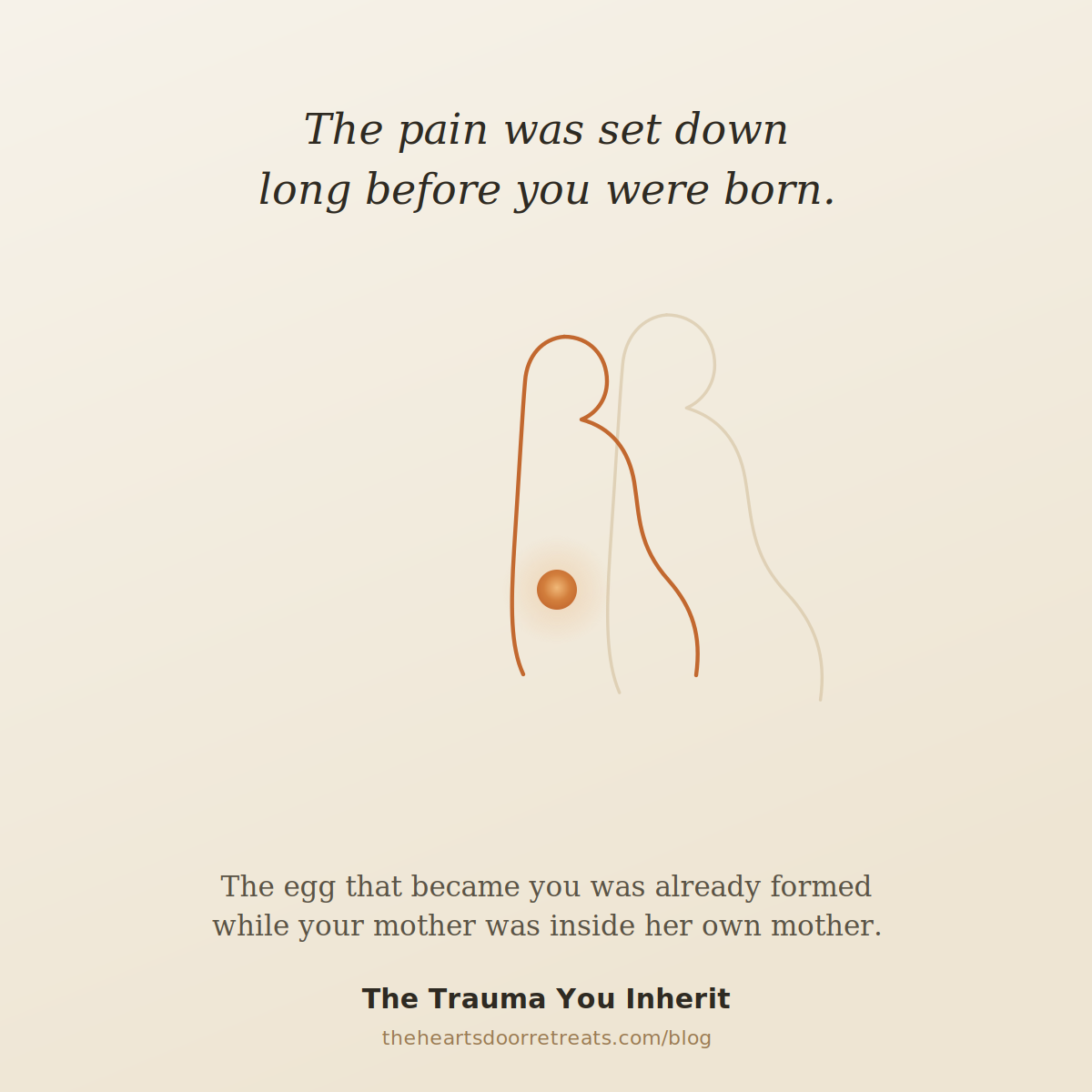
Which means the egg that became me was already present inside my mother while my mother was still a baby inside my grandmother.
Three generations, briefly, in one body.
So when I think about what my grandmother lived through, I am not thinking about something abstract and far away. I am thinking about a time when the earliest cell of me was already there. Already present. Already, perhaps, marked.
None of this proves what surfaced in my ceremony. A felt sense is not a lab result, and I would not pretend otherwise.
But the science does something important. It removes the easy dismissal. It says: the body of one generation can carry the mark of what happened to another.
Why a psychedelic ceremony is where it can finally move
What a ceremony can offer is a chance to finally feel what was not felt at the time when it happened.
Consciously.
In a body that is, this time, safe.
Because there was no danger in that yurt. And I knew it.
But I felt safe and I felt supported. By the guides and by the plant. Because in that altered state of consciousness something miraculous happens:
you can fully feel the pain, but you are not identifying with the pain.
And it was very painful.
I am not going to say it felt good.
It did not.
But it was not destabilising either, and that distinction is everything.
I could stay with it because I felt safe enough to stay.
And that safety did not come from nowhere. It came from a year of work, from ten ceremonies with the same people, from trust built slowly, from a guide whose hands knew what they were doing, and from something I had grown over that year — a trust in my own capacity to hold space for myself, and in the people around me to hold it with me.
What participants guided by me and Imke at The Heart's Door Retreats have said about their experience:
“Under different circumstances, what I experienced might easily have been called a “bad trip.” But because of their loving guidance, I was able to surrender to it. I was allowed to feel the fear I carried inside me. I was able to recognize that the pain I encountered during the experience was my own pain. It was pain that deserved to be felt.
And once I moved through that phase, it became something indescribably beautiful. It felt as if I had reached the very core of myself. I felt deeply connected to everything around me. Problems that had kept me mentally stuck in endless loops suddenly became visible from completely different perspectives. I felt entirely free from ego, self-doubt, and rigid patterns of thinking.”
— Rosa, Foundation retreat, November 2025 [read the full testimonial here]
Why this matters beyond me
I am telling you this not because my story is special, but because the mechanism is not.
So many people arrive at a ceremony with something they cannot explain. A grief that seems too big for their own life. A fear with no origin. A pattern that does not match anything they remember.
And they assume the problem is them — that they are broken in some private, personal way.
But sometimes what they are carrying was set down long before they were born.
And the relief of understanding that — of feeling, in the body, that this was never mine — is the beginning of putting it down.
And the safety of being able to feel it deeply is the moment when that energy can be integrated.
The plant did not give me the trauma.
It gave me the chance to feel what had been waiting to be felt.
And then to let it move through — so that it can stop its grip on my body and my life.
Post by co-founder Ioana Pop
If you are curious about what it actually feels like to work directly with psilocybin truffles— beyond the research — this kind of work happens in our Foundation Retreat: four days, a small group of ten, a private natural setting in the Dutch countryside, with breathwork and integration woven throughout, and a legal truffle ceremony held with care.
The next one is 23–26 July 2026.
If something here resonated, it may be the door you have been standing near for a while.
Ioana is a researcher, psychedelic facilitator, and coach whose work sits at the intersection of science, embodiment, and lived experience. She spent years inside academia studying psychedelics, health and wellbeing — and eventually decided the most useful thing she could do with that knowledge was bring it into the room with people, not just onto the page.
These posts are her attempt to make psychedelic science accessible and honest — without flattening it into wellness copy or drowning it in jargon. She works with individuals through 1:1 and group psilocybin ceremonies and co-leads Hearts Door Retreats, a retreat company offering multi-day psilocybin experiences in the Netherlands.
