What happens when you give rats a microdose of psilocybin?
The answer helps explain what 4,000 microdosing humans have been reporting for years
There is no shortage of stories about microdosing. Silicon Valley executives swearing by it. Mothers of three who say it changed their relationship with anxiety. Reddit threads thousands of posts long. The anecdotes are compelling, and they keep multiplying.
But anecdote is not data. So what does the research actually say?
The largest study to date
In 2021, a team of researchers from the University of British Columbia published what was, at the time, the largest study ever conducted on microdosing. They recruited over 8,700 people across 84 countries through an app called Quantified Citizen. Half were actively microdosing. The other half were not. Everyone completed the same questionnaires.
The headline finding was this: among people who reported existing mental health concerns — anxiety, depression, PTSD — those who were also microdosing scored significantly lower on standardized measures of depression, anxiety, and stress than those who weren't.
This is worth pausing on. This wasn't a comparison between sick people and healthy people. It was a comparison between two groups who both reported mental health struggles. The only difference was that one group was microdosing, and they were doing noticeably better on every measure.
A few more things stood out. The most common substance, by far, was psilocybin — used by 85% of microdosers in the sample. Most were dosing one to four times per week. More than half were combining their microdose with other substances, most commonly Lion's Mane mushroom and niacin, a practice known as stacking.
And the reasons people gave for microdosing? Overwhelmingly health-related. Reducing anxiety. Improving mood. Enhancing mindfulness. This wasn't a population chasing a high. It was a population trying to feel better, function better, live with less suffering.
The study also noted something about alcohol: microdosers were significantly more likely to abstain from it entirely. This small detail says something about the broader orientation of the people involved.
What the study can and cannot tell us
Here is where researchers have to be honest, and where journalists often aren't.
This was a cross-sectional study — a snapshot in time. It cannot tell us whether microdosing caused the lower levels of depression and anxiety, or whether people who are already slightly less symptomatic are simply more likely to microdose. The differences between the groups were statistically significant but modest. And the sample was self-selected: people who sign up for a microdosing study via a psychedelics podcast are not a random slice of humanity. They likely skew toward those who've already had positive experiences.
None of this makes the findings unimportant. An international sample of over 8,000 people, with a matched comparison group, is not nothing. It is, in fact, the kind of data the field had been missing. But it raises the obvious next question: what is actually happening? Is there a biological mechanism at work, or is this entirely expectation and self-selection?
Among people who reported existing mental health concerns — anxiety, depression, PTSD — those who were also microdosing scored significantly lower on standardized measures of depression, anxiety, and stress than those who weren't.
Enter the rats
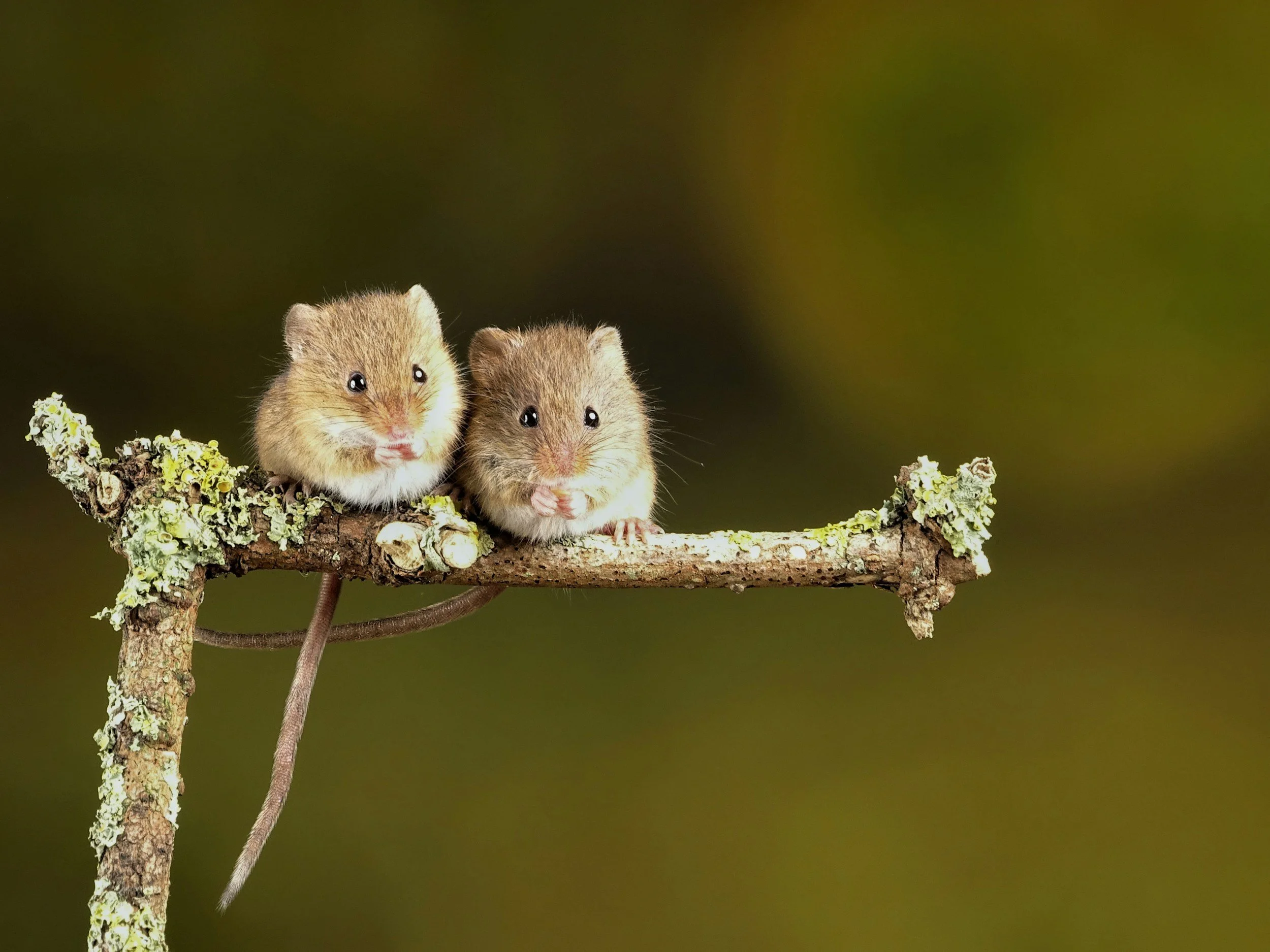
Human studies on microdosing have a fundamental problem: people know what they're taking. Expectation shapes experience — this is the placebo effect, and it's powerful. You can't easily blind someone to whether they took a psychedelic, even a tiny dose. Rats have no expectations. They don't know what they received. They don't read Reddit. So if a rat on psilocybin behaves differently from a control rat, it's the drug doing it — not belief.
In 2023, a team from Denmark published a study designed to do exactly this: establish what repeated low doses of psilocybin actually do in the brain, using an animal model where placebo effects are impossible.
The first challenge was methodological: what counts as a microdose for a rat? The researchers solved this rigorously. Using PET brain imaging — live, in the scanner — they measured how much of the brain's main psilocybin receptor (the serotonin 5-HT2A receptor) was occupied at different doses. In humans, we know that below 20% occupancy at this receptor, there are no psychedelic effects. The researchers found the rat equivalent: 0.05 mg/kg, every second day, for three weeks. This dose was confirmed by the absence of the giveaway sign: an involuntary full-body shudder rats produce when the receptor is strongly hit. No shudder, no psychedelic effect. A true microdose.
What the psilocybin rats showed
The researchers checked for everything that could go wrong first. Did the microdose create anxiety? No — tested in multiple environments, including a stress-inducing novel arena. Did it impair the brain's ability to filter out irrelevant stimuli? No — and this matters, because high doses of psilocybin produce exactly this impairment. Think of it as the brain's bouncer suddenly letting everything in: background noise, irrelevant sensations, thoughts that would normally be screened out. At microdose levels, the bouncer stayed at the door. Did the brain compensate by reducing its receptors, building tolerance — like when you drink coffee and you need more and more for the same effect? No.
Then the positive findings emerged.
Compulsive behavior decreased. Rats groom themselves repetitively — this is a well-validated proxy for compulsive behavior, driven by the same brain circuit implicated in OCD in humans. Psilocybin-treated rats groomed less frequently — a modest reduction in calm, familiar conditions, but a striking one when the animals were stressed and placed in an unfamiliar environment. Suggesting that what microdosing may be doing is not suppressing the behavior outright, but reducing the compulsive charge behind it — particularly when the pressure is on.
Stress resilience increased. This is the most elegant finding in the paper. Repeated injections are stressful for rats. Control animals showed the predictable stress response: declining interest in sugar water, a standard measure of anhedonia — which is the inability to experience pleasure, a core feature of depression. Psilocybin-treated animals showed the opposite. Their preference for sugar water actually increased during the treatment period. The stress didn't land the same way. These were healthy rats, not depressed ones — so this isn't an antidepressant effect so much as a resilience effect: the same external stressor produced less internal disruption.
When treatment stopped, the resilience disappeared. This suggests it's an active drug effect, not permanent rewiring.
Where in the brain?
After the behavioral tests, the researchers examined the brains. And here is where the study points to something very interesting.
In a small but specific brain region called the paraventricular thalamic nucleus — the PVT — they found something unexpected: a 60% increase in synaptic connections compared to control animals. Synaptic connections are how neurons talk to each other. More connections means more signal getting through — a stronger, more reliable conversation between brain regions.
And the conversation this particular region hosts matters. The PVT sits at the intersection of motivation, habit, and impulse — what researchers call approach-avoidance conflict.
You know something is bad for you; you still want it.
You have decided to stop; your body hasn't gotten the memo.
The PVT sits right at that junction, where the part of your brain that knows better tries to talk to the part that still wants to do it anyway. Your intentions and values on one side, your cravings and automatic behavior on the other. When that connection is stronger — when there are more synapses carrying the signal — your intentions have more say in what you actually do next.
This is speculative — animal data always is — but the logic is coherent: repeated low doses of psilocybin appear to strengthen the very circuit involved in choosing your intentions over your impulses.
What this adds up to
Two studies, two methodologies, one converging picture.
The Rootman study showed that a large, international, health-motivated population of microdosers reports lower depression and anxiety than comparable non-microdosers. The effect is real but modest, and causality cannot be established.
The Kiilerich study showed that in an animal model free from placebo effects, pharmacologically calibrated low doses of psilocybin reduce compulsive behavior, increase resilience to stress, and strengthen synaptic connections in a brain region involved in motivation and self-regulation. No anxiety, no receptor damage, no tolerance.
Neither study proves that microdosing works as a treatment. We don't have rigorous randomized controlled trials yet. What we do have is a convergence between what people report and what the biology suggests is possible — and a plausible location in the brain where the effects may be taking place.
That is not nothing. In a field that has been driven largely by anecdote, it's actually quite a lot.
At The Heart's Door Retreats we work with psilocybin in ceremonial and coaching contexts. Our work is grounded in both traditional practice and emerging research. If you have questions about microdosing, integration, or the research landscape, we're happy to talk.
Curious about our retreats combining psilocybin, breathwork and body-oriented practices? Read about our work here
