What Actually Happens in a Psychedelic Journey — Part 2: The Emotions
The science of emotional processing in psilocybin ceremonies — and why feeling it is not the same as thinking it.
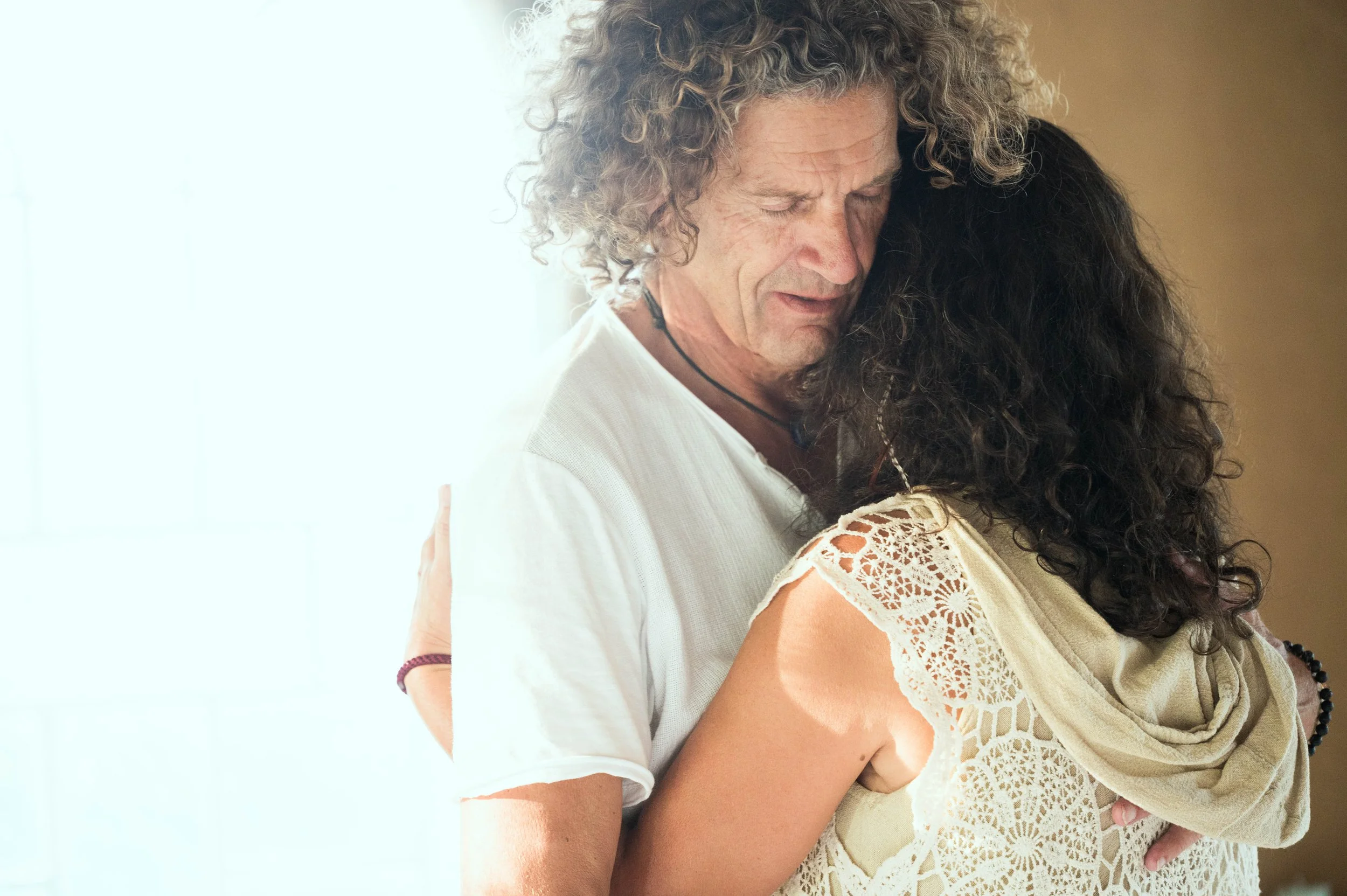
This is the second in a four-part series on what actually happens during a psychedelic journey. Part 1 covers bodily effects. Part 3 covers the mind — insights, shifts in thinking, changes in self-perception. Part 4 goes into mystical and spiritual experience. Each post stands alone, but they build on each other.
The story in this post is Ioana's own.
Emotion is not a thought
There is a phrase that comes from spiritual traditions — one that did not make sense to me for most of my adult life.
Emotion as energy in motion.
Feelings are not thoughts. They are events in the body — things that move through us when we let them, and stay lodged in us when we do not.
We do not think happy. We feel it.
And if the feeling is not there, the thought is just words.
What it looks like when the connection is missing
I knew I was supposed to feel proud of what I had built.
I had gotten out of post-communist Romania, out of a family that checked most boxes on any negative life events scale, out of a country that was — and in many ways remains — profoundly sexist and dismissive of women.
I had made a career.
I had the house, the work, the life that looked like the right answer from the outside.
And I felt none of it.
I lived almost entirely in my head. My body existed mainly to carry me from place to place, and was a considerable inconvenience with all its needs. I knew, intellectually, what I had accomplished. I could not feel it at all.
What the first ceremony opened
That changed during my first psychedelic ceremony.
The first night of that weekend, I cried for hours. I did not know why.
The images were vivid and layered — a film with its own symbolic logic — but I understood, somewhere beneath understanding, that what I was seeing was not what I was seeing.
It was a breakup that had never healed.
A shame I was still carrying.
A pain that had been stored in the body because there had been no moment, no container, in which it could be felt.
Until that night.
At the end of it came an image I will not forget: a painful memory that looked like an origami bird.
I released it upward, and it joined a river of origami birds — the painful memories of everyone who had ever lived, or would live.
And in that moment I felt, for the first time in my life, genuine compassion.
Genuine empathy.
The felt sense of belonging to something larger than my own story.
For someone with undiagnosed autism, that was not a metaphor. It was a first time.
The second night, I was braced for more grief.
Instead the medicine had other plans. I floated. I flew. I felt joy — real, physical joy — and then love, pouring out of me in a way I had genuinely never experienced.
And then, quietly, at the end: pride.
The felt sense of being proud of myself.
Not the idea of it.
The actual feeling, in the body, undeniable.
Because a psilocybin ceremony will bring up emotions. Often ones that have been waiting a long time. The preparation is not about predicting what will come. It is about building the capacity to meet it.
The full emotional spectrum
This is not a special story. It is a representative one.
The full emotional spectrum can move through a psychedelic experience — grief, fear, shame, joy, love, awe, compassion.
And it tends to move with an intensity that ordinary life rarely permits, because ordinary life rarely creates the conditions for it.
In the first post in this series, I explored how the sensory intensity of a psychedelic experience is not a side effect to be managed but the foundation of the work itself.
The same is true of emotional intensity.
It is not a risk to be minimised. In a well-held container, with proper preparation and guidance, emotional intensity is precisely the point — because it is what allows something to actually move.
What psychology has learned about processing emotions — and how we use it
Most of us were never taught how to feel.
Not really.
We were taught to manage emotions, push through them, reframe them, or wait until they passed. Turning toward a feeling — staying with it, letting it complete — is not something Western culture tends to model or reward.
Psychology is many ways is trying to recover what was lost.
One of the tools that came out of that effort is Focusing, developed by philosopher and psychologist Eugene Gendlin.
The idea is simple: instead of thinking about an emotion, you locate it in the body and stay with it — with curiosity, not judgment.
Gendlin called this a felt sense. Something you feel before you can name it. Something the thinking mind has not yet caught up to.
At The Heart's Door Retreats, we work with Focusing principles in the preparation before ceremony. Not as a technique to perform during the journey, but as a way of practising the most basic skill: noticing what is happening in the body, and not immediately running from it.
Because a psilocybin ceremony will bring up emotions. Often ones that have been waiting a long time. The preparation is not about predicting what will come. It is about building the capacity to meet it.
What the research says: critical periods and emotional learning
There is a concept in neuroscience called a critical period — a window of time, usually in early development, when the brain is especially open to learning certain things. Language is the clearest example.
Children absorb it almost without trying. Adults can learn a new language, but it costs more and rarely lands as deep.
These windows close. That is simply how development works.
What Gül Dölen's lab at Johns Hopkins found — published in Nature in 2023 — is that psychedelics reopen them. In mice, after psilocybin, the window for social and emotional learning came back open. The brain returned, temporarily, to that earlier state of receptivity.
The study was in mice, not humans. But if it points toward something real, the implication is striking.
It means that during a psilocybin experience, you may not simply be revisiting an old emotion. You may be in a moment where the brain can actually learn it — feel it fully, for the first time, as if the developmental window never quite closed after all.
Not a simulation. Not a memory. The actual thing, arriving late.
For those of us in the neurodivergent spectrum, this lands differently. Some emotional experiences — pride, compassion, felt empathy — were not just unfelt. They were genuinely not available. The window may have been open, but the conditions were not.
And beyond neurodivergence: most people carry emotions that were never felt because the moment they belonged to was not safe enough to feel them in.
Why people feel lighter afterwards
The body holds what could not be expressed. And in that holding, something freezes.
What people describe after a psychedelic experience — feeling lighter, more open, more themselves — is often exactly this: not an insight, but a release.
The emotion that had nowhere to go finally moved.
Because emotion is energy in motion.
And when it moves, it no longer needs to be stored.
The work of the facilitator, in this, is to hold the container steady enough that the feeling can come.
Not to direct it.
Not to interpret it.
To be present while someone finds their way through the fear, or the grief, or the shame — and to trust that on the other side of those feelings, something is waiting.
When there is safety and trust, it usually is.
"I am so glad that I found this retreat. I expected a lot and it was so much more than I could imagine it would be. All the exercises were so insightful and helpful, even this alone would be a precious and deep and meaningful retreat experience. The truffel ceremony was my first experience with phychedelics and you gave me a safe & loving & caring & respecting to be and feel. I now know why it is called a journey and I am very thankful for your guidance."
— Participant Foundation retreat, Nov. 2025
The next post in this series covers the mental dimension of a psychedelic journey — the insights and cognitive shifts.
Our Foundation Retreat — 23 to 26 July in the Netherlands — is built around exactly this: careful preparation, a ceremony held with full attention, and integration support that helps what arose in the journey take root in daily life. If you are curious whether this is the right moment for you, we would love to talk.
Post by co-founder Ioana.
Ioana is a researcher, psychedelic facilitator, and coach whose work sits at the intersection of science, embodiment, and lived experience. She spent years inside academia studying psychedelics, health and wellbeing — and eventually decided the most useful thing she could do with that knowledge was bring it into the room with people, not just onto the page. These posts are her attempt to make psychedelic science accessible and honest — without flattening it into wellness copy or drowning it in jargon.
